

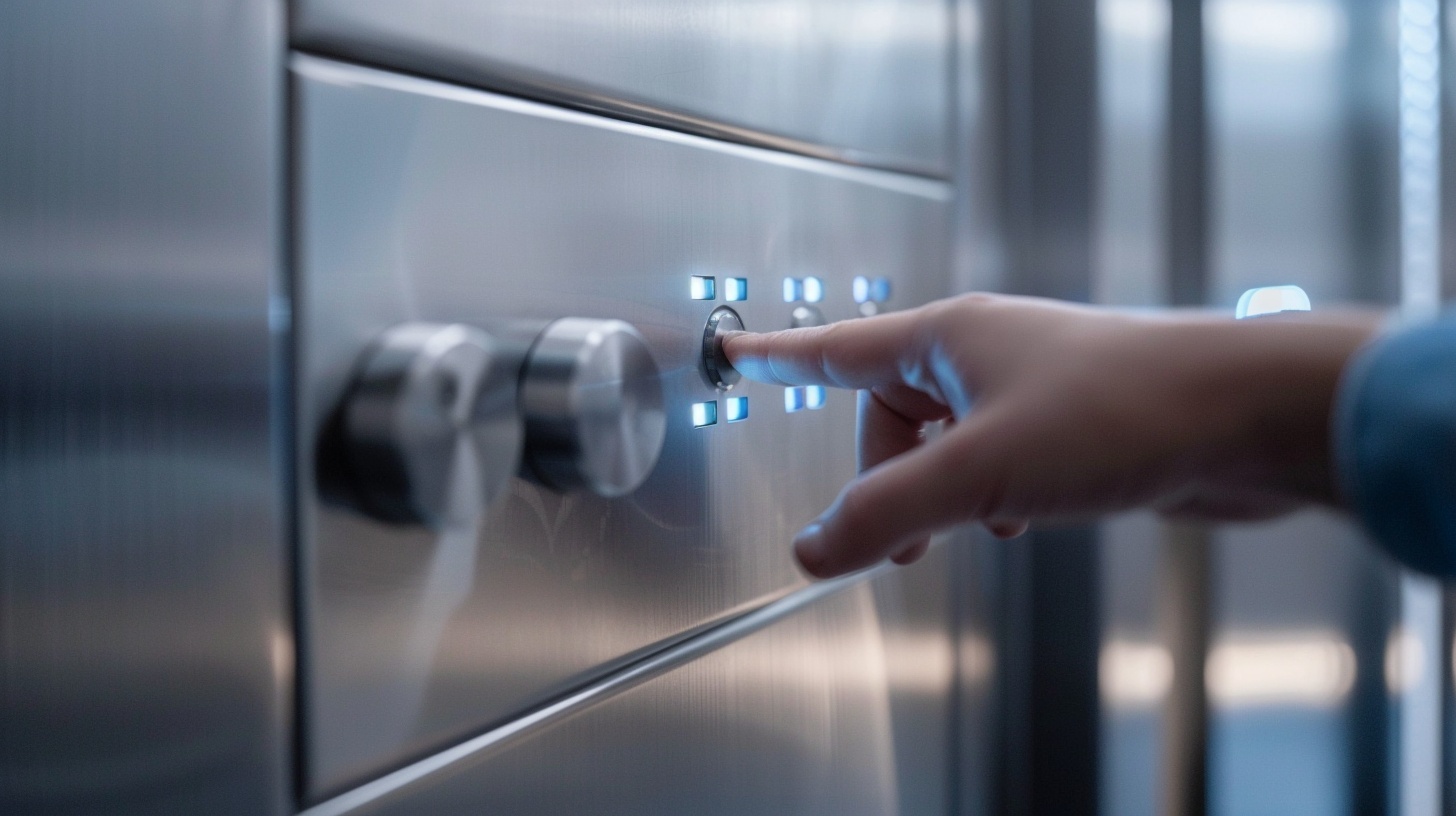
In many industrial products, a custom light indicator is often regarded as a functional component that displays operating status, signals faults or guides user interaction. During product development, however, it can become a defining element of the overall product.
Shape, colour, light output, symbols and integration all influence how equipment is recognised and experienced by the end user. This is why many OEM manufacturers choose solutions engineered around the characteristics of their products instead of adapting their designs to standard catalogue components.
The advantages extend far beyond appearance. A custom solution developed for a professional coffee machine, for example, can reinforce brand identity, improve usability, simplify mechanical integration and satisfy the technical requirements of specific industries and applications.
This article explores when a custom solution is worth considering, the key design decisions involved, how requirements vary across different applications and the most common mistakes to avoid during development.
Make your product instantly recognisable
Index
- Why customise light components
- When standard solutions are no longer enough
- Every project starts with a requirement
- How a custom lighting component is developed
- Beyond indicators: When light becomes part of the product
- Light indicators across different industries
- Common design pitfalls to avoid
- Design checklist: What to review before developing a custom light indicator
- Emerging trends in custom light indicator design
- Frequently asked questions
- Extra tips
- Glossary
- Great products are defined by their details
Why customise light components
Every industrial product is shaped by hundreds of design decisions. Some relate to cost, manufacturing processes and production efficiency, while others depend on the components selected. When a standard part forces changes to the front panel, limits functionality or compromises the product's appearance, the component itself starts dictating the design.
Customisation removes these constraints. A bespoke light component can be engineered around the specific requirements of the application, allowing designers to define dimensions, geometry, symbols, materials, colours and light output without adapting the product to a standard catalogue part.
Customisation may include:
- component dimensions and geometry;
- engraved symbols and surface finishes;
- backlit logos, text and profiles;
- colours and light output;
- materials and surface treatments;
- mounting systems and integration methods.
This approach becomes particularly valuable whenever light is part of the user experience. In professional equipment, medical devices, HoReCa appliances and operator interfaces, illuminated components help users understand machine status, confirm actions and navigate controls more intuitively.
For product designers and OEM engineers, this means working with a component developed around the actual requirements of the application from the earliest stages of development. The result is greater design freedom, smoother mechanical integration and a product that is consistent from both a technical and industrial design perspective.
A custom-designed component gives engineers
the freedom to develop a product
without compromising their design objectives.
When standard solutions are no longer enough
Standard components are often the starting point for a new product. They are easy to integrate, reduce development time and allow engineers to validate prototypes and early design concepts quickly.
As the product evolves, however, new requirements emerge. The HMI becomes more intuitive, the front panel reaches its final geometry, available space becomes more limited and every detail plays a role in defining the product's identity.
This is where the limitations of a component designed to fit thousands of different applications can become apparent. Dimensions, geometry, symbols, light output, materials or surface finishes do not always match the actual requirements of the project. As a result, engineers may find themselves adapting the product to the component instead of developing a solution that integrates seamlessly into the overall design and reflects current market expectations.
In these situations, a custom lighting solution provides greater design flexibility, simplifies mechanical integration and helps create an interface that is fully aligned with the product's brand identity.
Every project starts with a requirement
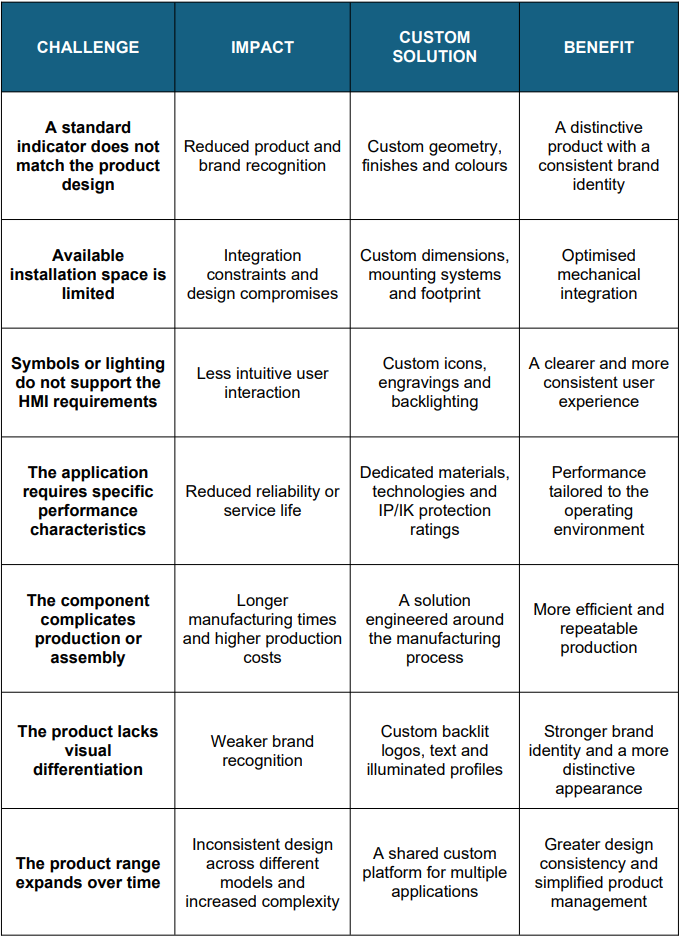
There is no single reason to develop a custom light indicator. Every project presents different engineering challenges and calls for a solution tailored to the application. The table below highlights some of the most common scenarios and the advantages of a custom-designed approach.
How a custom lighting component is developed
Developing a bespoke lighting component is not simply a matter of modifying an existing product. Every project begins with the application itself and the performance, integration and design objectives the final product is expected to achieve.
The first stage focuses on gathering the technical requirements. Typical considerations include:
- application characteristics;
- available space and integration constraints;
- operating environment;
- functional and aesthetic requirements;
- assembly and manufacturing processes.
Once the design requirements have been defined, engineering work begins. Geometry, symbols, materials, the lighting system, mounting method and surface finishes are developed as parts of a single integrated solution. At the same time, factors such as reliability, manufacturability and Design for Manufacturing (DFM) are evaluated from the earliest stages of development.
The same engineering approach applies to backlit logos, illuminated lettering and light guides. In these applications, attention extends beyond the lighting effect itself to include uniform light distribution, graphic legibility, seamless panel integration and consistency with the product's visual identity.
The outcome is a component engineered specifically for its application, combining technical performance, functional requirements and industrial design while reducing the need for design changes later in the development process.
The performance of a lighting component is shaped by the decisions made during the earliest stages of development.
Beyond indicators: When light becomes part of the product
The role of illuminated components has evolved significantly in recent years. What was once primarily used to communicate operating status has become an integral part of product design and user interaction.
Today, the focus extends beyond the indicator itself to the entire lighting concept that defines the appearance and usability of a machine or device.
From Status Indication to Visual Identity
More and more manufacturers use light as a distinctive product feature. Alongside traditional indicators, backlit logos, illuminated symbols and lighting profiles are increasingly incorporated into the overall product design.
These elements do more than enhance appearance. They make products instantly recognisable, create a consistent visual language across an entire product range and strengthen brand recognition.
Optical Engineering Meets Product Design
Developing an illuminated component involves much more than selecting an LED. Engineers must also consider lighting technology, including light distribution, uniformity, diffuser materials, colour temperature and the way light behaves under different operating conditions.
Mechanical engineering and optical engineering therefore evolve together from the earliest stages of product development, ensuring that performance, manufacturing requirements and industrial design remain aligned throughout the project.
The Trends Shaping the Market
The evolution of illuminated components reflects broader changes in industrial design. This is particularly evident in the appliance industry, where product design, user experience and brand identity have become key factors in the development of new products.
Some of the most significant trends include:
- closer integration between functionality and industrial design;
- components engineered alongside the product rather than adapted afterwards;
- wider use of backlit logos, illuminated symbols and lighting profiles as distinctive design elements;
- greater emphasis on interface ergonomics and usability;
- custom solutions that also simplify manufacturing and assembly.
Today, customisation is no longer limited to niche or premium products. It has become a practical engineering approach for developing products that are distinctive, consistent and competitive.
Manufacturers increasingly look for components capable of supporting future product development while addressing the evolving requirements of the home appliance and professional appliance sectors.
Light serves more than a functional purpose.
It reinforces product recognition while maintaining consistency with the brand's visual identity.
Light indicators across different industries
The requirements for a professional coffee machine manufacturer, as an example, are very different from those of a medical device developer or an industrial automation company. Even when the component performs the same function, the operating environment, technical requirements and design priorities are rarely the same.
For this reason, there is no universal solution. Every project begins with a thorough understanding of the application, the environment in which the component will operate and the performance it is expected to deliver.
Light Indicators for Professional Coffee Machines and HoReCa Equipment
In cafés, restaurants and hotels, coffee machines often operate continuously for many hours while remaining highly visible to customers. As a result, illuminated components are expected to do more than provide operational feedback, they become part of the machine's overall design language.
Alongside LED indicators, manufacturers increasingly integrate backlit logos, illuminated icons and lighting profiles that reinforce product recognition and strengthen brand identity.
Design must also address the demanding conditions of the HoReCa sector. Steam, heat, frequent cleaning and intensive daily use require reliable components that preserve both optical performance and visual quality over time. Maintaining a consistent design language across an entire product range is equally important, helping manufacturers build a strong and immediately recognisable brand identity.
Light Indicators for Industrial Automation
On a production line, operators often need to identify a machine's status at a glance, even from several metres away or under challenging lighting conditions. Industrial lighting technology therefore plays a critical role in communicating information quickly and clearly, helping reduce errors during operation, adjustment and maintenance.
Development focuses on reliability, visibility and continuous operation. Vibration, dust, moisture and demanding duty cycles require components capable of delivering consistent performance throughout their service life.
Mechanical integration is equally important. Components must fit seamlessly into operator panels, electrical cabinets and Human-Machine Interfaces (HMI) while simplifying installation, maintenance and manufacturing without compromising visibility or ergonomics.
In many industrial applications, lighting technology must also ensure uniform visibility under all operating conditions, minimising glare, shadows and poorly distinguishable signals that could slow operator response.
Light Indicators for HVAC and Technical Equipment
Control panels for heat pumps, air handling units and ventilation systems often need to accommodate multiple functions within a very limited space. Illuminated components must therefore integrate seamlessly into the interface without increasing the installation footprint while maintaining excellent readability and a clean, consistent appearance.
Key design considerations include:
- available installation space and panel integration;
- thermal management and continuous operation;
- uniform light distribution and clear information display;
- ease of assembly and maintenance;
- long-term reliability despite temperature and humidity variations.
This engineering approach produces components that meet the specific constraints of HVAC equipment while simplifying product integration and manufacturing.
Light Indicators for Lighting Technology and Lighting Systems
In the lighting industry, every detail contributes to the perceived quality of the final product. Beyond delivering functional status information, illuminated components must integrate naturally into the product without disrupting its overall design language.
Several SLIM projects demonstrate how bespoke lighting components can meet functional, manufacturing and aesthetic requirements simultaneously.
Examples include:
- HAGER – Custom illuminated components developed for iconic switches and control devices.
- BTicino – A project showcasing the seamless integration of illuminated elements into electrical installation products.
- HAGER Australia – A Good Design Award-winning project recognised internationally for its engineering and industrial design.
These projects demonstrate that successful solutions depend on balancing optical performance, mechanical integration and visual quality from the earliest stages of development.
Light Indicators for Outdoor and Public Applications
EV charging stations, vending machines and illuminated signage operate continuously in environments exposed to rain, dust, heat and intensive public use. Components must continue to perform reliably for years while maintaining visibility and operational dependability.
Achieving this requires careful consideration of IP (Ingress Protection) ratings, IK (Impact Protection) ratings, corrosion-resistant materials and clear visibility in both daylight and night-time conditions.
When equipment is installed in public spaces, interface robustness and long-term reliability become essential for reducing maintenance requirements and ensuring a dependable user experience.
Light Indicators for Medical Devices
In medical equipment, every visual signal must be immediately understood. Unclear or poorly visible indications can delay operator response and increase the risk of misinterpretation. Illuminated components must therefore provide precise visual feedback, uniform light output and an interface designed with ergonomics in mind.
These requirements are complemented by strict expectations regarding reliability, hygiene and manufacturing compliance. Surface finishes and integration methods must withstand repeated sterilisation and cleaning cycles while maintaining consistent performance throughout the product's lifetime.
The result is an interface that supports safe operation, improves day-to-day usability and integrates naturally with the overall design of the medical device.
Explore Custom Components and Application Solutions
Common design pitfalls to avoid
Developing a bespoke illuminated component requires balancing mechanical, optical, manufacturing and aesthetic considerations. If key requirements are overlooked during the early stages of development, the result is often design revisions that increase development time, costs and manufacturing complexity.
Some of the most common pitfalls include:
- Leaving the lighting component until the final stages of development, when the available space, mounting system and overall product architecture have already been defined.
- Failing to consider the operating environment from the outset, including weather exposure, ambient lighting conditions, cleaning cycles, intensive use and regulatory requirements.
- Designing solutions that are difficult to manufacture, requiring complex assembly processes, additional machining or inefficient production methods.
- Treating each element as a separate component, rather than developing geometry, materials, light output, mounting and mechanical integration as parts of a single, integrated solution.
The most successful projects take a holistic approach from the very beginning, developing technical requirements, manufacturing constraints and functional objectives together instead of addressing them as separate design stages.
Working with the manufacturer from the earliest stages of development helps minimise design changes, streamline manufacturing and deliver a component that is fully integrated into the final product.
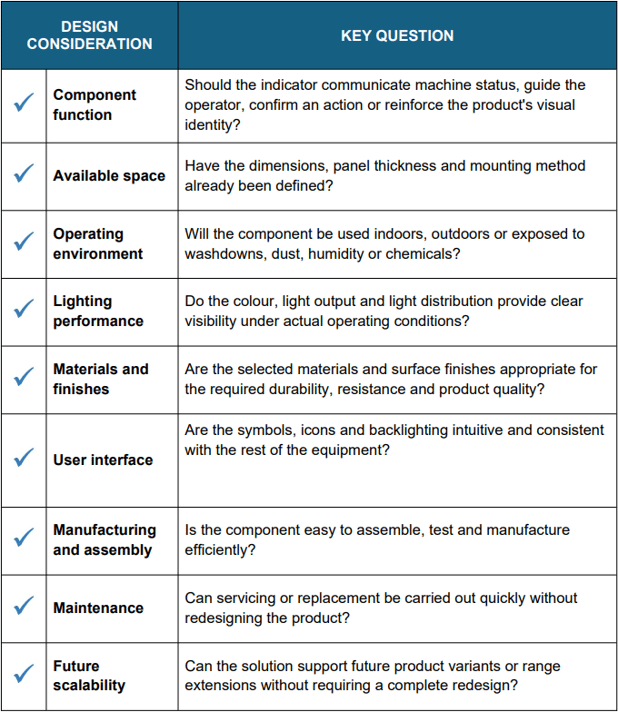
Design checklist: What to review before developing a custom light indicator
Emerging trends in custom light indicator design
The role of light indicators has evolved significantly. Beyond communicating machine status, they now contribute to interface quality, product recognition and the overall user experience.
The biggest change lies in the way these components are designed. Industrial design and functionality are increasingly developed together, resulting in cleaner surfaces, backlit symbols, uniform illumination and components that integrate seamlessly with the appearance of the product while maintaining high levels of performance and reliability.
At the same time, manufacturers are placing greater emphasis on solutions developed around the specific requirements of each product. The objective extends beyond visual differentiation to include easier integration, more efficient assembly and long-term manufacturing consistency.
Customisation should not introduce unnecessary manufacturing complexity. When a component is developed from the earliest stages of a project, it can be engineered to fit existing assembly processes, minimise secondary operations and simplify the management of multiple product variants.
The same evolution is driving advances in materials and manufacturing technologies. More efficient optical diffusers, increasingly precise manufacturing processes and improved production techniques make it possible to develop components that deliver greater reliability, longer service life and consistent quality across a wide range of applications.
Custom development is no longer a niche approach, it is becoming the standard for manufacturers looking to create products that are distinctive, easier to manufacture and ready to evolve with changing market requirements. Developing a lighting component in partnership with an experienced manufacturer helps ensure that it meets the specific needs of the application while strengthening product identity throughout its lifecycle.
Frequently asked questions
When does it make sense to develop a custom light indicator?
A custom solution becomes the right choice when a standard component no longer meets the requirements of the application. This may be due to space constraints, aesthetic objectives, dedicated symbols, demanding operating environments or the need to create a more distinctive product. In these situations, a bespoke component improves integration, functionality and long-term manufacturing efficiency.
Which features can be customised?
Almost every aspect of an illuminated component can be tailored to the application, including dimensions, geometry, materials, surface finishes, colours, symbols, light distribution, mounting systems and electrical characteristics. Combining these elements makes it possible to develop a solution that meets the technical, functional and aesthetic requirements of the product.
Does a custom solution increase development time?
Developing a bespoke component requires an initial engineering phase, but it often reduces design revisions later in the project. Involving the manufacturer from the earliest stages helps identify application constraints early and develop a solution that is also optimised for manufacturing.
Can a custom light indicator be manufactured in high volumes?
Yes. Bespoke components are designed with manufacturing and assembly requirements in mind from the outset. The objective is to deliver a solution that can be produced reliably and consistently while maintaining high quality throughout the entire production lifecycle.
Which industries use custom light indicators?
Custom solutions are widely used across industries, including professional coffee machines, medical devices, industrial automation, HVAC equipment, lighting systems, vending machines and outdoor applications. Each sector presents its own technical requirements, which directly influence the design of the component.
Extra tips
Define the product's lighting identity from the outset. Colours, symbols, light output and lighting behaviour should be developed alongside the product—not added once the design is nearly complete. This ensures the illuminated component becomes a genuine part of the product's identity and strengthens brand recognition.
Start with the application, not the component. Before evaluating existing solutions, define the functional, environmental and aesthetic requirements of the project. Customisation delivers the greatest value when it is driven by the product's needs rather than by adapting a standard catalogue component.
Involve the manufacturer early. Working with the manufacturer during the early stages of development makes it possible to evaluate geometry, materials, technologies and assembly methods before design constraints begin to limit the available options.
Think beyond a single product. If the project includes multiple models or future product extensions, developing a common platform of bespoke illuminated components can simplify engineering, maintain a consistent visual identity and reduce manufacturing complexity.
Evaluate the component as a complete solution. An illuminated component should never be selected solely for its visual appearance. Mechanical integration, reliability, manufacturability, long-term supply continuity and product recognition are just as important as lighting performance in determining the success of the final design.
Glossary
Impact Protection (IK Rating)
A classification defined by IEC 62262 that measures a component's resistance to mechanical impacts. It is particularly important for applications exposed to intensive use, vandalism or installation in public environments.
Human-Machine Interface (HMI)
The collection of controls and visual elements that allow users to interact with a machine or device. Light indicators, push buttons, displays and illuminated symbols are all part of the HMI and contribute to a more intuitive user experience.
Design for Manufacturing (DFM)
An engineering approach that ensures a component can be manufactured and assembled efficiently while reducing production costs, secondary operations and potential manufacturing issues. DFM is a key consideration throughout the development of bespoke components.
Backlighting
A lighting technique in which LEDs illuminate symbols, text or logos from behind, improving visibility while enhancing the product's appearance and visual identity.
Light Output
The visible light emitted by a component. It includes characteristics such as brightness, uniformity and colour, all of which influence readability and user experience.
Lighting Technology
The combination of design principles, optical solutions and manufacturing technologies used to control light distribution, appearance and performance within illuminated components and user interfaces.
Great products are defined by their details
The best solutions are not those that draw attention to individual components, but those in which every element works together as part of a cohesive whole.
The same principle applies to the development of a custom indication and signalling system. The objective is not to add a distinctive feature, but to engineer a component that feels like an integral part of the product from the very beginning.
Whether you are developing a new product or looking to customise the illuminated components across your existing range, the SLIM engineering team can help you design a solution built around your specific technical and manufacturing requirements.
Do you already have a product design or 3D rendering?