

During the development of a new product, everything may appear to be on track until the testing phase reveals a compliance issue.
It could be a LED indicator that does not provide the service life required to support ESG objectives, or a device that does not help meet the energy efficiency targets defined for the final application.
Compliance slowing your project?
Today, compliance and energy efficiency are key design requirements, particularly in sectors such as HVAC, outdoor equipment, gardening, professional appliances and OEM industrial applications.
Selecting a signalling solution now involves much more than evaluating its technical performance. Even a single indicator light can influence product safety, regulatory compliance, operational reliability and the overall energy efficiency of the finished system.
Index
- Why compliance and sustainability matter
- How to choose safe and compliant LED indicators
- Operational safety: The role of visual signalling
- LED energy efficiency: reducing energy consumption without compromising performance
- The role of lighting components in ESG and industrial sustainability
- Circular economy and responsible design
- HVAC, indoor air quality and the energy transition
- Why supply chain reliability matters
- Safety and sustainability: two sides of the same coin
- Issues affecting safety, compliance and sustainability
- Common mistakes to avoid
- Frequently Asked Questions
- Additional recommendations
- Checklist: verify safety, compliance and sustainability before making your selection
- Glossary
- Better decisions start early
Why compliance and sustainability matter
Safety regulations, ESG strategies, energy efficiency, service life and supply chain continuity all influence the quality and long-term sustainability of an industrial product.
A single non-compliant part or incomplete technical documentation can delay approvals, testing activities and production start-up.
This is why OEMs, manufacturers and procurement teams increasingly require detailed information about materials, technical specifications, reliability and manufacturing capabilities before selecting a supplier.
Today, purchasing decisions go far beyond price. Signalling systems are expected to maintain reliable operation throughout their service life while supporting regulatory compliance, energy efficiency targets and certification processes.
Consider an HVAC installation: an indicator must remain fully functional for years without interruption. Outdoor applications place different demands on status lights, which are exposed to humidity, UV radiation and continuous temperature variations.
Ignoring environmental conditions or applicable regulations at the design stage often leads to redesigns, delays and additional costs later in the project.
Long-term reliability starts with compliance,
safety and informed design decisions.
How to choose safe and compliant LED indicators
Choosing a LED indicator involves much more than checking size, colour or supply voltage. At SLIM, these aspects are discussed from the earliest stages of every project, because selecting the right solution means understanding how it will fit into the final application. Voltage, IP rating, materials, electrical connections, light output and operating conditions all need to be considered together to minimise redesigns and streamline product development.
No two applications operate under the same conditions. An indicator designed for an indoor electrical panel faces very different requirements from one installed on outdoor equipment or machinery exposed to frequent washdowns.
Professional appliances are a good example. Regulatory compliance has a direct impact on product certification, while energy efficiency requirements introduced by the ErP Directive continue to influence design decisions across the industry.
Before selecting a solution, it is worth verifying:
- the appropriate IP rating for the operating environment;
- material compatibility with humidity, UV exposure, chemicals and high temperatures;
- the reliability of electrical connections;
- consistent light output throughout the product's service life;
- the availability of technical documentation and the required certifications.
Addressing these points early helps reduce redesigns, simplify certification activities and improve the overall reliability of the finished product.
Operational safety: the role of visual signalling
A misinterpreted warning, the absence of a visual alert or a status indication that fails to reflect the actual condition of a machine can have consequences that go well beyond production downtime. In industrial environments, situations like these increase the risk of incorrect actions, inappropriate interventions and equipment being operated under unsafe conditions.
This is why visual signalling is an integral part of functional safety. Indicator colours, activation logic, positioning and message consistency should enable operators to understand the machine's status immediately, whether they are monitoring normal operation, performing maintenance or carrying out diagnostics.
Operational safety also depends on how clearly a machine communicates its status.
LED energy efficiency: reducing energy consumption without compromising performance
In many industrial applications, the power consumption of a single indicator light may seem insignificant. The picture changes when the same solution is installed across hundreds or thousands of units expected to operate continuously for many years.
This is a common scenario in HVAC systems, HoReCa equipment and other industrial applications designed for continuous operation, where even a small reduction in power consumption can deliver substantial savings over the product's lifetime.
Achieving higher energy efficiency involves more than selecting the right LED. Light distribution, thermal management, electronic control and expected service life all influence the overall performance of the signalling system.
An oversized indicator may draw more power than necessary while generating unnecessary heat. Conversely, insufficient light output can reduce visibility and make operation less intuitive.
The most efficient solutions balance optical performance, electronics and real operating conditions. Optimising light distribution or refining the electronic control system often delivers the same level of visibility while using less energy.
The role of lighting components in ESG and industrial sustainability
ESG criteria are often associated with manufacturing facilities, energy consumption and corporate policies. In reality, design decisions also influence a product's environmental impact and the way it performs throughout its operational life.
A visual indicator designed for long-term reliability requires fewer maintenance activities, fewer replacement parts and fewer service interventions over time.
Every intervention that can be avoided reduces the resources required for manufacturing, transport, logistics and end-of-life processing, helping improve the overall sustainability of the project.
This is also why the choice of a technology partner has become increasingly important. OEMs and manufacturers now look beyond technical specifications, paying close attention to regulatory compliance, supply chain resilience, long-term component availability and the transparency of their suppliers' manufacturing processes.
ESG objectives become meaningful when they are reflected in product design and engineering choices.
Circular economy and responsible design
By now, it is clear that many decisions affecting a product's environmental impact are made long before manufacturing begins. Material selection, ease of maintenance and the ability to replace individual parts without replacing the entire assembly all influence how efficiently resources are used throughout the product's lifecycle.
Product architecture, assembly methods and engineering choices also have a direct impact on manufacturing efficiency and long-term product management. Designing with these factors in mind helps reduce waste while making better use of available resources.
For OEM manufacturers, this means adopting a broader design perspective. Reducing unnecessary materials, simplifying the integration of lighting systems and minimising waste all contribute to a more efficient production process without compromising reliability or performance.
The same principle applies to vending machines and other equipment designed for continuous operation, where thoughtful engineering helps reduce resource consumption, maintenance requirements and the overall environmental footprint.
A circular economy therefore, goes far beyond end-of-life recycling. It begins with the way a product is designed, manufactured and used throughout its service life.
Reduce Waste
HVAC, indoor air quality and the energy transition
Heating, ventilation and air conditioning account for a significant share of a building's energy consumption while playing a key role in maintaining healthy indoor environments. Improving their efficiency has therefore become a priority in both new developments and refurbishment projects.
In these applications, clear visual signalling allows technicians and maintenance teams to assess operating conditions quickly and identify potential issues before they develop into more complex faults.
The need for reliable monitoring is especially important in offices, hospitals, schools, hotels and commercial buildings, where climate control operates continuously and has a direct impact on occupant comfort, indoor air quality and energy use.
For this reason, indicator lights must remain easy to read and dependable throughout their service life. Poor visibility or unexpected failures can delay fault diagnosis, complicate maintenance and extend equipment downtime.
Why supply chain reliability matters
A signalling solution may meet every technical specification and still become a critical issue if it is unavailable when production begins. In industrial manufacturing, supply continuity and a resilient supply chain have a direct impact on delivery schedules, production planning and the ability to meet customer commitments.
A delay involving a single part can interrupt assembly, postpone testing and slow the start of production. OEM manufacturers know this well, particularly in high-volume or continuous manufacturing environments where the availability of every item affects the entire production schedule.
Selecting a supplier therefore involves much more than comparing product specifications. Key factors include:
- manufacturing capacity;
- organisational stability;
- long-term material availability;
- continuity of supply.
A well-managed supply chain helps manufacturers plan procurement more effectively, reduce unexpected disruptions and keep production running smoothly, even when delivery schedules are particularly demanding.
The right supplier adds value far beyond the component itself.
Safety and sustainability: two sides of the same coin
Safety and sustainability are often treated as separate priorities. In engineering practice, however, many design decisions improve both at the same time.
A signalling solution designed to withstand demanding operating conditions requires fewer repairs, fewer replacement parts and fewer resources throughout its service life. At the same time, compliance with applicable regulations helps prevent delays during certification, testing and product validation.
The same principle applies to energy efficiency. Lower power consumption supports environmental objectives while reducing heat generation and limiting stress on electronic components.
Whether the application involves HVAC, outdoor equipment, gardening or OEM manufacturing, these priorities naturally converge. Reliability, regulatory compliance, supply continuity and energy efficiency are closely interconnected and should be considered together from the earliest design stages.
Choosing an indicator should therefore involve more than comparing technical specifications or initial cost. Its long-term impact on operational safety, maintenance requirements, energy use and system availability deserves equal attention.
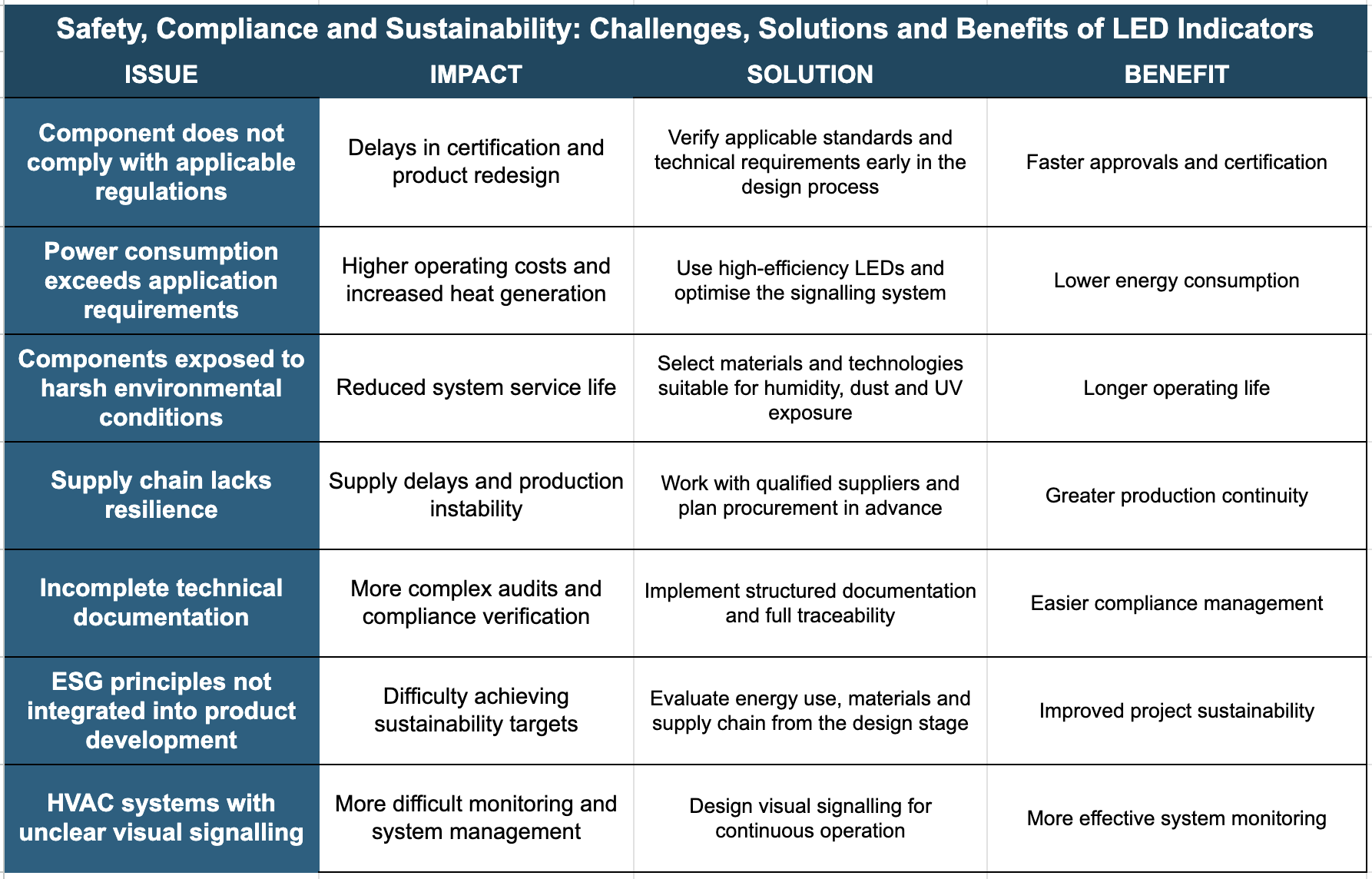
Issues affecting safety, compliance and sustainability
Safety, regulatory compliance and sustainability are influenced by multiple design factors, not just the technical characteristics of a signalling device. The following examples summarise common engineering challenges together with practical approaches to overcome them.
Common mistakes to avoid
Leaving Regulatory Compliance Until the End of the Project
Reviewing regulations and certifications only after product development is complete can lead to redesigns, approval delays and additional costs.
Choosing a Supplier Based on Price Alone
A low-cost indicator may result in higher long-term costs due to more frequent replacements, increased maintenance and reduced operational reliability.
Overlooking Real Operating Conditions
Humidity, dust, UV exposure, vibration and temperature fluctuations can significantly affect the performance and service life of a signalling solution.
Underestimating Supply Chain Reliability
Even a technically sound solution loses value if it is unavailable when needed or if the supply chain cannot guarantee long-term continuity.
Treating Sustainability as a Marketing Exercise
Real sustainability is achieved through engineering decisions involving energy consumption, product durability, material selection and manufacturing processes—not through environmental claims alone.
Ignoring System Energy Efficiency
Even seemingly minor components can have a measurable impact on overall energy consumption when deployed across hundreds or thousands of units.
Frequently Asked Questions
Which certifications and regulations apply to industrial LED indicators?
Requirements vary depending on the application and target market. The most common include CE marking, UL certification for the North American market, VDE standards in Europe, as well as compliance with RoHS, REACH and, where applicable, the ErP Directive.
Why is energy efficiency important for LED indicators?
Lower power consumption helps reduce operating costs, minimise heat generation and decrease the environmental impact of a product throughout its service life.
How do you choose a LED indicator for outdoor applications?
Key factors include the appropriate IP rating, resistance to weather, UV exposure and long-term reliability under demanding environmental conditions.
How do LED indicators support ESG objectives?
Energy consumption, service life, material selection and supplier reliability all contribute to a product's environmental performance and help companies achieve their ESG goals.
Why is supply chain reliability important when selecting signalling components?
A resilient supply chain helps prevent production delays, material shortages and unexpected disruptions, ensuring greater continuity throughout the manufacturing process.
How do LED indicators improve HVAC systems?
They support system monitoring, diagnostics and maintenance by providing clear visual feedback that helps technicians assess operating conditions quickly and efficiently.
Additional recommendations
Address compliance requirements from the outset. Reviewing regulations and certification requirements during the early design stages helps avoid redesigns, delays and unnecessary development costs later in the project.
Look beyond technical specifications. The same signalling solution may perform very differently depending on whether it is installed in an HVAC system, outdoor equipment or a professional appliance. Always evaluate the real operating environment.
Make supply continuity part of your design strategy. Component availability and supply chain resilience directly influence production planning, delivery schedules and long-term manufacturing continuity.
Assess total cost of ownership. Purchase price is only one part of the equation. Energy consumption, maintenance requirements, service life and operational reliability often have a much greater impact over the lifetime of the product.
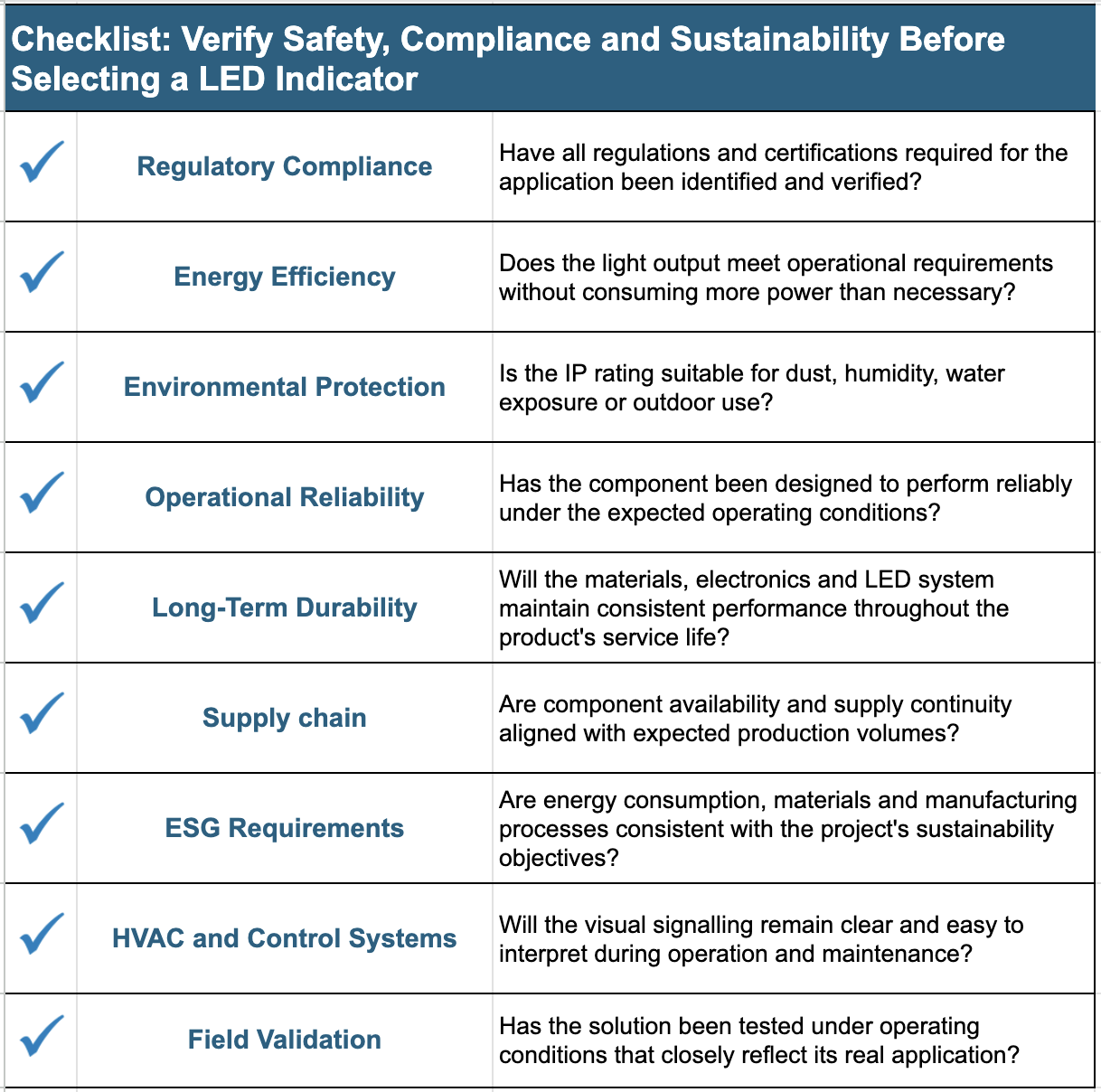
Checklist: verify safety, compliance and sustainability before making your Selection
Before selecting a LED indicator for a new application, it is worth reviewing a few key aspects that can influence certification, operational reliability, energy efficiency and supply continuity. Addressing these factors early helps minimise technical issues and avoid costly changes later in the development process.
Glossary
ErP Directive
European legislation establishing ecodesign requirements for a wide range of products, with the aim of improving energy efficiency and reducing environmental impact.
RoHS
European Directive restricting the use of specific hazardous substances in electrical and electronic equipment.
REACH
European Regulation governing the registration, evaluation, authorisation and restriction of chemicals to protect human health and the environment.
IP Rating
International classification that defines the level of protection provided by an indicator or enclosure against the ingress of dust, solid objects and water.
ESG
Environmental, Social and Governance criteria used to assess an organisation's sustainability performance and the way it manages its business and manufacturing activities.
Better decisions start early
Light performance, regulatory compliance and energy efficiency are only part of what determines the success of an industrial project. Long-term reliability, supply continuity and suitability for the intended application are equally important when developing products designed to perform over time.
Addressing these factors from the earliest design stages helps minimise redesigns, simplify certification and improve long-term product reliability.
Integrating safety, compliance and sustainability into the design of visual signalling creates a stronger foundation for successful industrial development.
Looking for a signalling solution that combines
compliance, reliability and sustainability?