


In an OEM project, defining a light indicator too late in the development process may seem like a minor detail. In reality, it can lead to wiring modifications, PCB redesigns, assembly issues, additional testing, production delays, higher development costs, and a longer time-to-market.
When working with light indicators, LED circuits, or custom lighting solutions, reducing costs and lead times starts long before production begins. It starts with the decisions made during the design and development phase.
Do design and technical changes affect your OEM development?
This scenario is particularly common in sectors such as professional coffee machines, HVAC systems, household appliances, vending machines, and industrial control panels, where electronics, mechanics, and production requirements must be aligned from the earliest stages of development.
From this perspective, designing an OEM light indicator is not simply about selecting a component. It means developing a solution that streamlines integration, assembly, and long-term manufacturing efficiency.
Aspects such as electronic design, printed circuit boards (PCBs), LED microcircuits, supply chain management, and technical support become key factors in improving development efficiency and ensuring production stability.
An efficient custom project is built when development, industrialization, and manufacturing are treated as parts of the same process rather than as separate stages.
Table of Contents
- How to Reduce Time-to-Market in Projects Involving Light Indicators
- Custom light Indicators: when a tailored solution reduces costs and lead times
- From prototype to production: how to avoid rework and late design changes
- Circuit boards and LED microcircuits: integrating electronics and light signaling
- Industrialization and high-volume production
- Common challenges in OEM projects involving light indicators
- Inventory management and supply circuity in industrial projects
- Why technical support from the supplier accelerates OEM development
- Testing and Validation: How to Prevent Production Issues
- Mistakes to avoid
- Frequently Asked Questions
- Extra tips
- Glossary
- When to involve SLIM in an OEM project
How to reduce time-to-market in projects involving light indicators
Reducing a product's time-to-market means eliminating the delays and complexities that tend to accumulate throughout development, testing, and production ramp-up.
In OEM projects, many delays occur when light indicators, electronic boards, or LED systems are integrated without considering material availability, ease of assembly, and manufacturing compatibility from the outset.
In applications such as professional coffee machines, commercial appliances, and HVAC control panels, even seemingly minor changes can have a significant impact. A small variation in component dimensions or wiring layout may require additional technical validation, PCB redesigns, and further testing activities.
To genuinely accelerate development, it is essential to minimize design revisions and avoid late-stage modifications.
Using components already designed for mass production, together with standardized connections and mounting systems, helps simplify both industrialization and assembly processes. Early involvement of the supplier also makes it possible to identify potential incompatibilities before they become costly delays.
In many cases, solutions already optimized for OEM applications help shorten development cycles and reduce the number of engineering revisions required.
Production planning and supply management are equally important. Scheduled component availability and well-organized processes help prevent disruptions during industrialization and manufacturing, keeping projects on track from development to market launch.
Custom light indicators: when a tailored solution really reduces costs and lead times
In OEM manufacturing, customizing a component does not necessarily mean increasing complexity or extending development timelines. In many cases, a purpose-designed solution simplifies integration, assembly, and production management, resulting in a more stable and predictable development process.
Challenges typically arise when standard components are forced to meet highly specific design requirements. Limited installation space, high operating temperatures, mechanical constraints, or compact electronic architectures can turn the integration of a simple light indicator into a continuous exercise in compromise.
This situation is common in professional coffee machines, built-in appliances, and HoReCa equipment, where every design detail directly affects the overall balance of the product.
In these applications, a custom solution can help:
- reduce space requirements and mechanical modifications
- simplify wiring and assembly operations
- improve integration with electronic boards and PCBs
- accelerate industrialization and mass production
Customization is therefore not only about the component itself, but about how that component fits into the overall product architecture.
In the most efficient OEM projects, a tailored solution is not used to make the product more complex. Instead, it is designed to simplify everything that follows: manufacturing, assembly, testing, and long-term product management.
Case History: Lighting integration in the ILVE Panoramagic Project
In the Panoramagic project developed for ILVE, the integration of light indicators and backlighting required a highly precise balance between electronics, available space, and lighting uniformity.
To address challenges related to component positioning, light distribution, and panel integration, SLIM developed a custom solution that included a dedicated PCB, a light guide, and components specifically engineered for the appliance's architecture.
The objective was not only to achieve a consistent visual result, but also to simplify integration, assembly, and system reliability throughout both production and real-world operation.
This approach helped reduce late-stage modifications and improve continuity between product development, industrialization, and mass production.
From prototype to production: how to avoid rework and late design changes
When an application moves from the prototype stage to industrial production, challenges often emerge that were not apparent during the initial development and testing phases.
Assembly issues, inadequate tolerances, thermal management constraints, or manufacturing incompatibilities can delay production ramp-up and increase the need for costly rework.
In professional coffee machines, for example, limited space and high operating temperatures require components specifically designed to ensure long-term reliability. In HVAC control panels and industrial equipment, factors such as accessibility, mounting solutions, and compatibility with automated manufacturing processes become equally critical.
The manufacturing technologies used by the supplier also play a key role in determining the precision, repeatability, and reliability of the final product. Projects that require tight tolerances or complex geometries often benefit from advanced manufacturing processes such as sinker EDM (Electrical Discharge Machining), which enables highly accurate components and consistent quality across large production volumes.
When industrialization and manufacturing requirements are considered only at the final stages of development, the likelihood of late design changes increases significantly.
Printed circuit boards and LED microcircuits: integrating electronics and light signaling
When size constraints, thermal management, and long-term operational reliability become critical factors, electronics and light signaling can no longer be designed as separate elements. Printed circuit boards (PCBs), LED microcircuits, and lighting systems have a direct impact on the compactness, reliability and manufacturability of the entire product.
Challenges often arise when electronic boards and LED systems are developed without fully considering real operating conditions, production constraints, and thermal performance requirements.
In professional appliances and compact equipment, available space is increasingly limited. In HVAC control panels and industrial systems, priorities shift toward electrical stability, continuous operation, and long-term reliability.
For this reason, PCB design must go beyond component performance alone. It should also take into account mechanical integration, ease of assembly, and compatibility with mass-production processes.
Using PCBs specifically designed for lighting and signaling applications helps improve light uniformity, reduce space requirements, and enhance the overall operational reliability of the whole system.
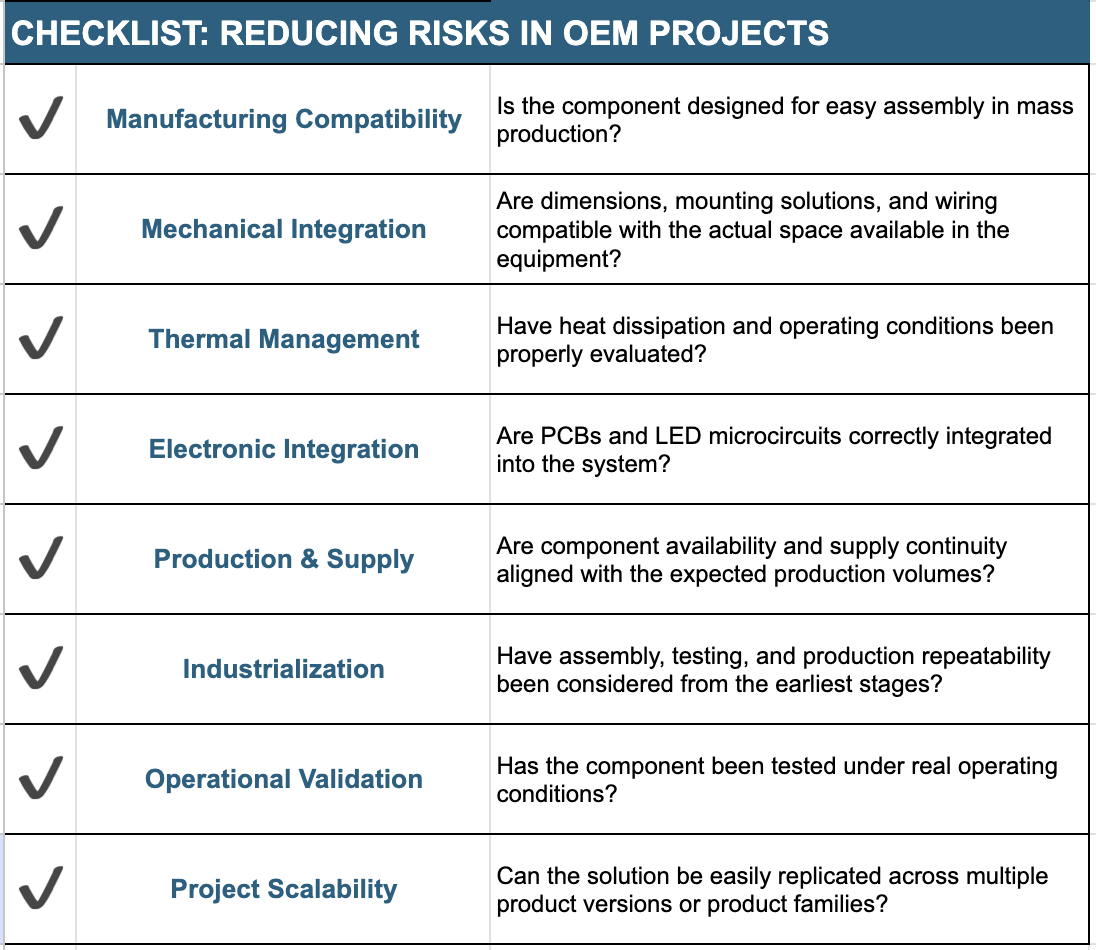
Industrialization and high-volume production
In high-volume manufacturing environments, every detail has a direct impact on lead times, production costs, and supply reliability. A light indicator that is difficult to assemble or an overly complex electronic board can slow down production and increase the risk of errors on the assembly line.
This becomes particularly critical in sectors such as vending machines, HoReCa equipment, and HVAC control systems, where production volumes demand processes that are fast, repeatable, and easy to control.
Designing with industrialization in mind from the outset helps to:
- simplify assembly and installation processes
- reduce production lead times
- minimize waste and rework
- improve production continuity and operational stability
Manufacturing processes play a key role in ensuring the consistency of large-scale production, especially when high standards of precision and repeatability are required. The same applies to internal organization and production capacity, which are essential factors in maintaining reliable OEM supply chains.
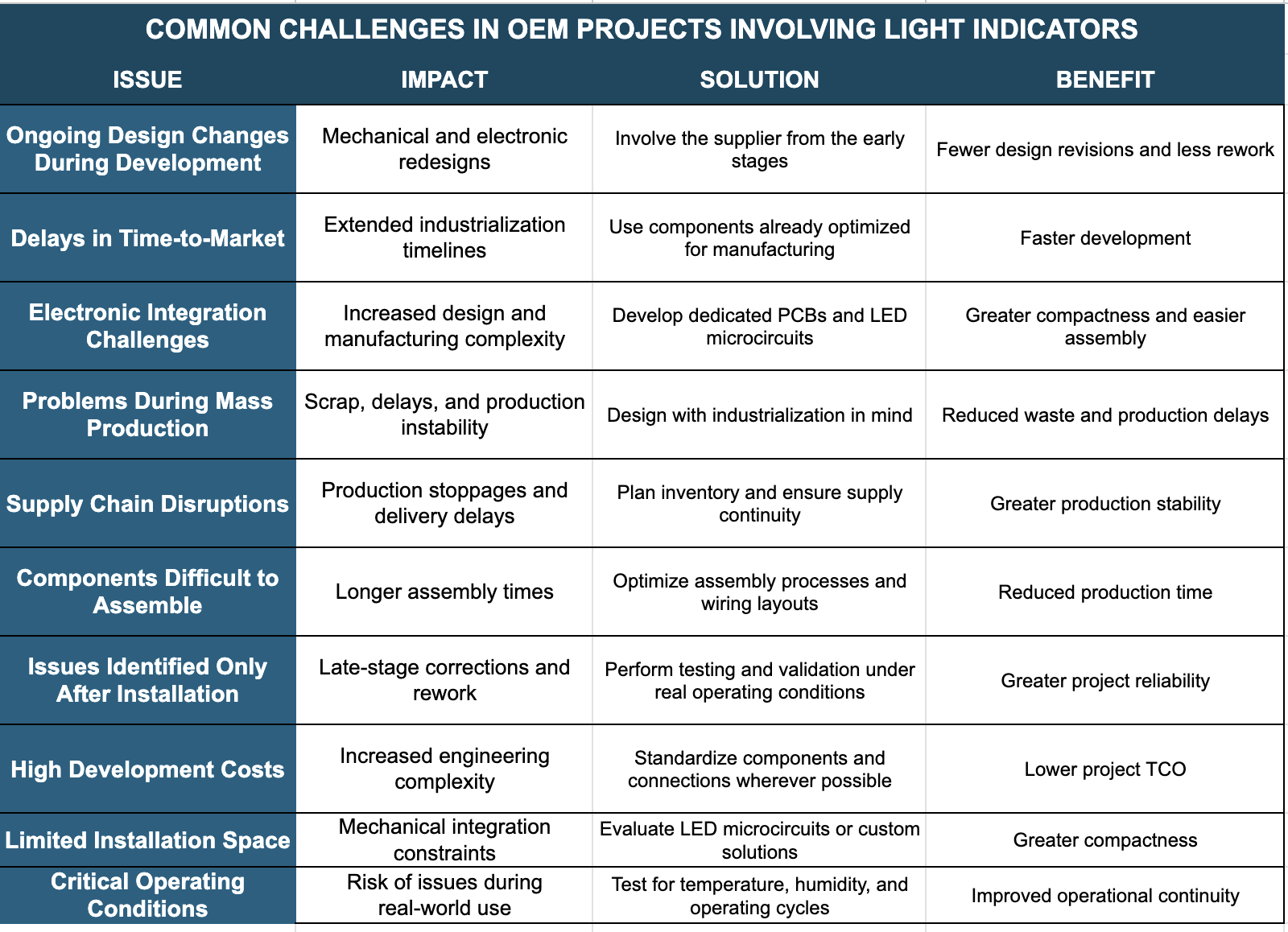
Common challenges in OEM projects with light indicators
Challenges in OEM projects rarely stem from a single component. The table below summarizes some of the most common issues encountered during the development and industrialization of light signaling systems, highlighting their impact on the project, recommended design approaches, and the operational benefits that can be achieved through proper planning.
Inventory management and supply continuity in industrial projects
In custom OEM projects, component development is only part of the challenge. The real complexity arises when production schedules, procurement activities, and material availability must remain aligned over time.
Supply delays, inefficient inventory management, or component shortages can slow down assembly operations, deliveries, and production planning, particularly in industries characterized by continuous manufacturing or high production volumes, such as household appliances, vending machines, professional coffee equipment, and HVAC systems.
In reality, the true cost rarely corresponds to the value of the missing component itself. The greater impact comes from production downtime, urgent logistics activities, planning disruptions, and increased pressure on operations management.
Scheduled component availability, coordinated procurement processes, and efficient supply chain organization help minimize production interruptions and unexpected disruptions. The same applies to long-term supplier partnerships, especially when projects involve custom-designed components or large-scale manufacturing programs.
A reliable supply chain helps prevent
delays, hidden costs, and production disruptions.
Why technical support from the supplier accelerates OEM development
In complex custom manufacturing projects, a supplier does much more than provide a component. A qualified supplier becomes a technical partner, helping to reduce development time, simplify integration, and prevent issues during industrialization and production.
When technical support is involved too late in the process, the outcome is often the same: repeated design changes, engineering revisions, and increased development costs.
This is particularly relevant in sectors such as professional coffee machines, household appliances, and HVAC systems, where electronics, mechanics, and light signaling solutions must coexist within increasingly compact spaces. Early technical collaboration helps identify potential issues before they become costly project constraints.
Effective technical support helps to:
- quickly assess project feasibility
- identify solutions compatible with manufacturing and assembly requirements
- reduce the need for late-stage design modifications
- accelerate testing, validation, and industrialization activities
This collaborative approach is what enables the development of solutions truly optimized for specific OEM requirements. The same principle applies to the commercial and operational management of the project, which directly influences response times and the ability to adapt to evolving production needs.
Technical support from a lighting component supplier should not be viewed as a tool for solving problems after they arise, but as a way to prevent issues before they slow down development.
Testing and validation: how to prevent production issues
Many issues do not emerge during the design or prototyping stages, but only when the component is actually integrated into the final product and begins operating under real conditions.
To truly accelerate development, testing and validation should not be treated as a final checkpoint. They should be considered an integral part of the industrial development process.
A light indicator may perform perfectly in a laboratory environment yet reveal limitations once deployed in real-world applications. High temperatures, vibration, continuous operating cycles, or harsh environmental conditions can directly affect stability, service life, and overall reliability.
In professional coffee machines, for example, heat and humidity are often the main challenges. In HVAC control panels and industrial equipment, long-term operational reliability, electronic compatibility, and continuous performance become equally critical.
Testing components under actual operating conditions makes it possible to identify potential issues before full-scale production begins, reducing rework, limiting design changes, and preventing delays during assembly and production ramp-up.
Testing early prevents costly issues
when the project reaches the production line.
Mistakes to avoid
Defining lighting components too late in the development process
One of the most common mistakes is treating light indicators and LED assemblies as secondary elements and addressing them only in the final stages of the project. This often leads to incompatibilities, late design changes, and delays during industrialization and manufacturing.
Forcing standard components into highly specific applications
Trying to adapt off-the-shelf components to requirements they were not designed for frequently results in mechanical modifications, assembly difficulties, and increased development costs.
Separating product design from industrialization
When manufacturing constraints and assembly requirements are not considered from the beginning, the likelihood of rework and engineering revisions increases significantly.
Underestimating inventory management and supply continuity
In projects intended for mass production, even minor supply chain disruptions can affect manufacturing schedules and delivery performance, particularly in high-volume or continuous production environments.
Performing validation only at the end of development
Many issues become visible only under real operating conditions. Postponing testing and validation until the final stages of development increases both correction costs and project timelines.
Viewing the supplier as only a manufacturer
In complex OEM projects, the supplier's technical expertise is an integral part of the development process. Early collaboration can help reduce errors, shorten development cycles, and minimize the need for late-stage modifications.
Frequently Asked Questions
How can OEM projects reduce time-to-market?
Reducing time-to-market requires minimizing late-stage design changes, selecting components already optimized for manufacturing, and involving suppliers early in the development process. Addressing production and integration requirements from the beginning helps prevent delays later on.
When does it make sense to develop custom light indicators?
A custom solution is often the best option when standard components create integration, assembly, or manufacturing challenges. In many cases, a tailored design helps reduce overall project costs and shorten development cycles.
Why should design and industrialization be developed together?
Many issues only become apparent during assembly and production. Considering manufacturing requirements from the design stage helps avoid rework, engineering revisions, and production delays.
What role do PCBs and LED microcircuits play in OEM projects?
PCBs and LED microcircuits are essential for optimizing electronic integration, reducing space requirements, improving thermal management, and simplifying manufacturing processes.
How can production issues be minimized in high-volume manufacturing?
Components should be designed with assembly, testing, and mass production requirements in mind. Real-world validation and operational testing are also critical to identifying potential issues before full-scale production begins.
Why is supply continuity important in OEM manufacturing?
Component shortages and supply delays can disrupt production schedules, assembly operations, and deliveries. A reliable supply chain helps maintain manufacturing continuity and prevents unnecessary operational costs.
Extra tips
Design with industrial manufacturing in mind from the start
Many issues arise when a prototype must be converted into a production-ready product. Considering assembly requirements, tolerances, and wiring layouts from the earliest stages helps minimize late-stage modifications and engineering revisions.
Reduce the number of different components
Standardizing connections, mounting systems, and component types simplifies manufacturing, maintenance, and inventory management while improving overall production efficiency.
Evaluate supply availability and continuity early
In high-volume manufacturing environments, component selection should not be based solely on technical performance. Production capacity, inventory management, and supply chain reliability are equally important factors.
Involve suppliers during the development phase
Early technical collaboration helps identify potential challenges before they become costly issues during industrialization and manufacturing. The sooner key stakeholders are involved, the smoother the development process becomes.
Glossary
Thermal management
The process of controlling and dissipating the heat generated by LEDs, electronic circuits, and lighting components during operation. Effective thermal management improves system stability, extends service life, and enhances long-term reliability.
Dimensional tolerance
The allowable variation in a component's dimensions during manufacturing. Dimensional tolerances directly affect assembly accuracy, mechanical compatibility, and production repeatability.
LED microcircuit
A compact electronic assembly that integrates LEDs, electrical connections, and light management components within a limited space. It is used to improve integration, miniaturization, and light uniformity in OEM applications.
Printed Circuit Board (PCB)
An electronic board used to connect and manage electronic components and LED systems. In industrial projects, PCB design directly influences compactness, thermal performance, reliability, and ease of assembly.
Industrialization
The process of transforming a prototype into a product suitable for mass production. It includes considerations such as assembly methods, production repeatability, manufacturing lead times, tolerances, and supply continuity.
Sinker EDM (Electrical Discharge Machining)
A high-precision manufacturing process that uses controlled electrical discharges to machine metal components with complex geometries or extremely tight tolerances. It is widely used in industrial applications requiring exceptional accuracy, repeatability, and consistent production quality.
When to involve SLIM in an OEM project
The best time to involve a light indicator supplier is not after the component has already been selected, but while the project is still defining key requirements such as space constraints, connections, production processes, and operating conditions.
At this stage, SLIM can support engineering teams, R&D departments, and technical buyers in identifying the most suitable solution for the application, whether it is a standard product, a customized configuration, or a fully bespoke design.
Early collaboration helps prevent integration issues, reduce development risks, and streamline the transition from concept to production.
Looking to accelerate development and industrialization?